
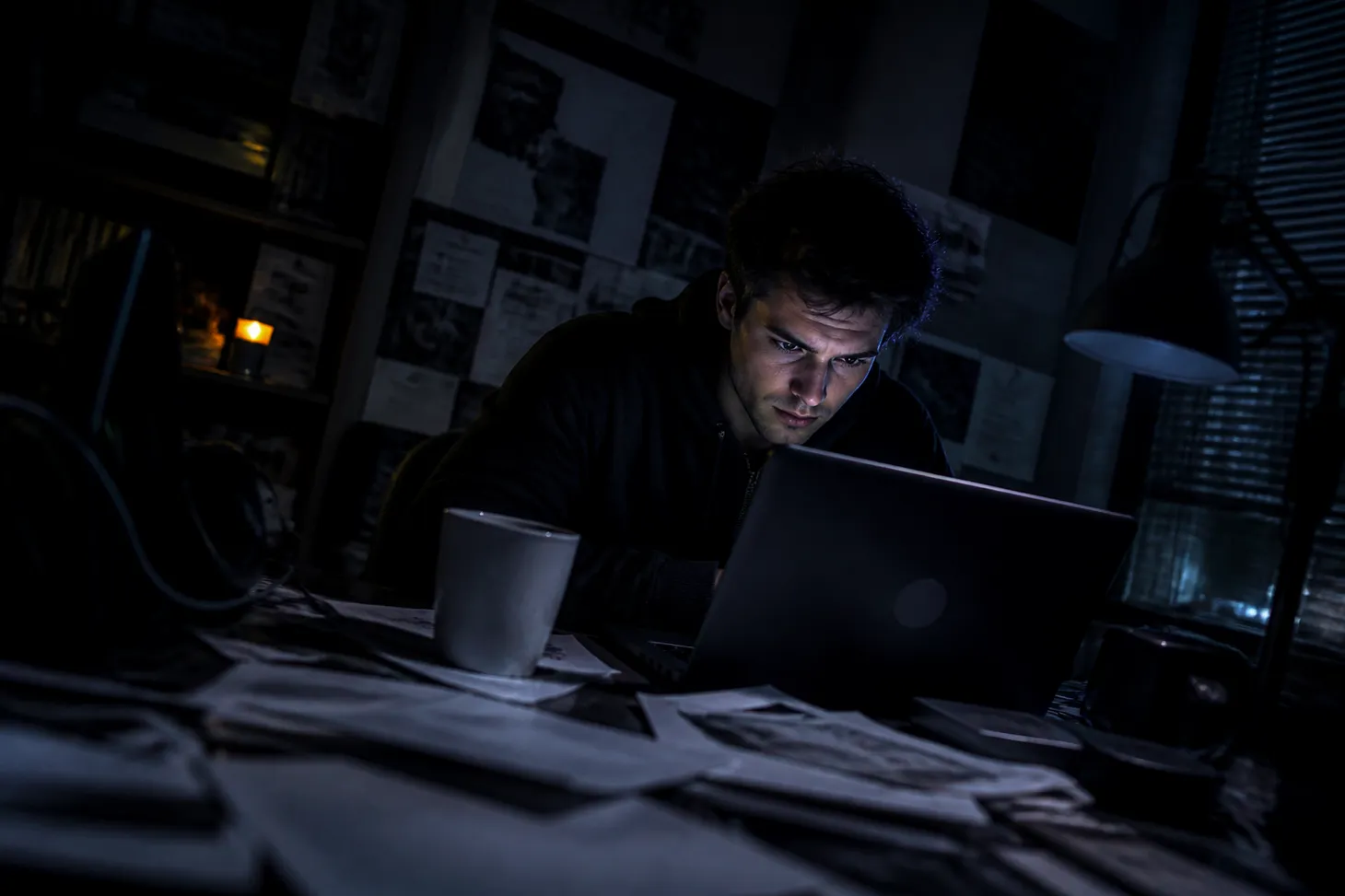
The ‘Unfriended Dark Web’ meme refers to a reaction image or GIF from the 2018 screenlife horror film, used to joke about being watched, hacked, or pulled into ominous online activity. The movie is fiction: a character finds hidden files on a laptop and is monitored[1][2], but the organized murder-auction ‘Circle’ has no documented real-world equivalent[3]. Director Stephen Susco did draw on real phenomena like swatting and extortion[4].
What the 'Unfriended Dark Web Meme' Actually Refers To
The 'Unfriended Dark Web meme' is a reaction image or GIF taken from the 2018 screenlife horror film Unfriended: Dark Web[1][5]. It typically shows a character staring into a webcam with a frozen, shocked, or uncomfortable expression. You'll recognise the framing: tight close-up, harsh laptop lighting, the awkward angle of a video call. The meme is not about the dark web itself—it's a visual shorthand for digital dread, the moment you realise someone is watching, or the split second before a video call goes wrong.
Two variants circulate most widely:
Guy staring at camera: The protagonist Matias (played by Colin Woodell) looking directly into his webcam, often mid-conversation or mid-discovery[5][2].
'Meme girl' variant: A female character in a similar frozen, wide-eyed pose during a group video call.
Both serve the same purpose: expressing 'I've seen something I shouldn't have' or 'this Zoom meeting just got awkward'. The film's premise—Matias steals a laptop from a cybercafé and discovers a massive archive of hacked webcam footage[2]—lends the meme its surveillance-paranoia flavour. People deploy it when a browser tab betrays them, when they accidentally unmute on a call, or when they stumble onto disturbing content online.
The meme spread through Reddit, Imgur, and reaction-image boards, often captioned with variations of 'me realising my webcam was on' or 'POV: you clicked the wrong link'. It's a reaction format, not commentary on the actual dark web. For context on what the dark web is and how it differs from the film's fiction, see our Dark Web Definition: What You Should Know.
The core appeal: the webcam framing makes the viewer feel complicit, as if they're the one watching—or being watched.
Origin: The Scene Behind the Image
Unfriended: Dark Web was released in 2018 as a standalone sequel to the 2014 supernatural horror Unfriended[5]. Both films belong to the 'screenlife' genre: the entire story unfolds through a laptop screen—browser tabs, video calls, file windows, and notifications[6][5]. You never leave the desktop. The original Unfriended followed a Skype group haunted by a vengeful ghost[6]; the 2018 sequel dropped the supernatural element and leaned into real-world threats like hacking, swatting, and surveillance[4][3].
The meme images come from moments during a Skype-style group video call, when the characters realise they're being monitored by whoever owns the stolen laptop[1][7]. The most common template features Matias O'Brien, played by Colin Woodell, staring directly into his webcam[5][2]. The scene captures him frozen mid-conversation, harsh laptop lighting washing out his face, the webcam angle slightly too low—exactly how you look when you're trying to explain something uncomfortable on a video call. That frozen, deer-in-headlights expression became the meme.
A second variant—often labelled the 'meme girl' reaction—comes from a different character in the same group call, typically during a moment of escalating panic. Both shots share the same aesthetic: tight framing, unforgiving webcam quality, the sense that someone is watching through the screen. The film's supporting cast includes Rebecca Rittenhouse, Betty Gabriel, and Connor Del Rio[5], and reaction shots from their characters occasionally appear in meme compilations.
The screenlife format is what makes these stills so memeable. The webcam framing feels raw and immediate—closer to a Zoom screenshot than a traditional film still. You've probably made that exact face yourself during a work call gone wrong.
Why This Reaction Format Spread
The meme works because the character's expression reads as 'calm on the surface, terrified underneath'—a relatable response to online horror. Matias stares into the camera with a neutral face, but his eyes betray panic. That duality mirrors how you act when something goes wrong on a video call: you freeze, maintain composure for the other participants, and internally spiral. The webcam framing amplifies the effect. You're not watching a polished film performance; you're looking at someone through a laptop camera, exactly as you would during a Zoom meeting or Discord chat.
The screenlife format lowers the barrier for reuse. Because the footage looks like a real video call—complete with compression artefacts, awkward angles, and harsh lighting—it slots naturally into digital-life jokes. You don't need context from the film to understand the image. The webcam framing does the work. When someone captions the still with 'me realising my mic was on the whole time' or 'POV: you opened the wrong folder in a screen share', the joke lands immediately.
The meme belongs to the broader 'guy staring at camera' family, a template category that includes formats like 'Blinking White Guy' (from a 2013 YouTube video) and 'Hide the Pain Harold'. All share the same structure: a direct-to-camera look that conveys discomfort, awkwardness, or suppressed dread. The Unfriended: Dark Web variant adds a surveillance layer—the sense that someone is watching you through the screen, not just the character. That makes it especially useful for jokes about hacking, privacy breaches, or stumbling onto disturbing content online.
Observable usage patterns on Reddit, Imgur, and Know Your Meme show the template appearing in three main contexts:
Accidental exposure: 'When you forget to close your tabs before screen sharing.'
Digital paranoia: 'Me after clicking a sketchy link at 3 a.m.'
Awkward video calls: 'POV: your boss asks if you've been working from home.'
The meme peaked in circulation during 2019–2020, coinciding with the shift to remote work and the explosion of video-call culture. The webcam-stare format became a visual shorthand for the low-level dread of always being one click away from embarrassment—or worse.
Common Mistakes When Using or Identifying the Meme
Four errors appear repeatedly when people share or discuss this reaction format. Each weakens the joke or spreads confusion about what the meme actually depicts.
Confusing the Two Films
The most common mistake: assuming the meme comes from Unfriended (2014) instead of Unfriended: Dark Web (2018). The original Unfriended is a supernatural horror about a vengeful ghost haunting a Skype call[6]; the 2018 sequel dropped the ghost and focused on surveillance, hacking, and real-world threats[1][4][5]. The reaction images circulate from the sequel, not the original. This matters because the meme's surveillance-paranoia tone comes specifically from the 2018 film's premise—a stolen laptop full of hacked webcam footage[2]. If you caption the image with references to ghosts or Laura Barns (the antagonist from the 2014 film[6][8]), the joke doesn't align with the source material. The two films share a title prefix and screenlife format, but their premises differ entirely.
Mislabeling the Character
People often caption the meme as 'random scared guy' or 'guy on webcam' without identifying him as Matias O'Brien, the protagonist played by Colin Woodell[5][2]. This error doesn't usually break the joke—reaction memes rarely require character knowledge—but it does strip away context. Matias isn't a passive victim caught on camera; he's the one who stole the laptop and triggered the surveillance nightmare[1][2]. That irony adds a layer: the expression isn't just fear, it's the realisation that his own actions brought the watchers to his door. When you know the character's role, the frozen stare reads differently—less 'I'm being watched' and more 'I caused this'. For deeper context on the film's plot, see Unfriended Dark Web: The Real Story.
Using the Image to Mean 'Dark Web Content' Literally
A third mistake: treating the meme as if it depicts actual dark web activity or represents what you'd encounter on hidden services. The film is fiction[1][3], and the meme is a reaction format, not a literal illustration of dark web content. When someone posts the image alongside captions like 'what you see on the dark web' or 'dark web users be like', they've misunderstood the template. The meme expresses the feeling of digital dread—being watched, hacking paranoia, stumbling onto something disturbing—not the technical reality of Tor or .onion sites. The film's organised murder-auction 'Circle' has no documented real-world equivalent[3], and director Stephen Susco based the story on phenomena like swatting and extortion, not dark web marketplaces[4]. If you want to joke about surveillance or awkward video calls, the meme works. If you're trying to illustrate what the dark web actually is, it doesn't.
Cropping Out the Webcam Framing
The fourth error: cropping the image so tightly that the webcam context disappears. The meme's power comes from the screenlife framing—the low angle, harsh lighting, and video-call aesthetic that makes the still feel like a Zoom screenshot rather than a film scene. When you crop to just the face, you lose the 'someone is watching through the camera' layer. The joke becomes generic surprise instead of digital-specific dread. The webcam framing is what separates this template from other 'guy staring at camera' formats. You need the context of the screen to make the surveillance paranoia land. A tight crop might work for a general reaction, but it weakens the meme's original purpose: capturing the exact moment you realise your camera was on, or someone saw what you were doing online.
Each mistake shifts the meme's meaning or strips away the detail that makes it effective. You don't need to have watched the film to use the template correctly—but you do need to understand it's a reaction to digital discomfort, not a literal depiction of dark web activity or a scene from the 2014 ghost story.
The 'Unfriended' vs 'Unfriended: Dark Web' Confusion
Both films use the screenlife format—the entire story unfolds through a laptop screen—and both feature tight webcam shots of characters mid-panic[6][5]. That visual similarity causes the most frequent mix-up: people assume the meme comes from the 2014 original when it actually traces to the 2018 sequel. The confusion is understandable. The titles share a prefix, the aesthetics overlap, and reaction shots from both films circulate in the same meme ecosystems. If you've never watched either, the stills look identical.
Here's the distinction that matters for meme attribution. Unfriended (2014) is a supernatural horror film directed by Levan Gabriadze, in which a group of teenagers on a Skype call are haunted by the vengeful ghost of Laura Barns, a classmate who died by suicide after an embarrassing video went viral[6]. The film was originally titled Cybernatural and is told almost entirely through a screencast of a MacBook[6]. The antagonist is a ghost using social media to torment the characters[6][8]. Reaction images from this film do exist—frozen expressions during the haunting—but they carry a supernatural-horror context, not surveillance paranoia.
Unfriended: Dark Web (2018) drops the ghost entirely. Writer-director Stephen Susco's standalone sequel follows Matias O'Brien, who steals a laptop from a cybercafé's lost and found and discovers a massive archive of hacked webcam footage organised by address[1][2]. The film was Susco's directorial debut and stars Colin Woodell, Rebecca Rittenhouse, Betty Gabriel, and Connor Del Rio[5]. The antagonist isn't supernatural—it's a coordinated group of dark web users who monitor Matias and his friends through their own cameras[1][7]. Susco intentionally based the events on real-world phenomena like swatting, identity theft, and online extortion[4], though the film's organised murder-auction 'Circle' remains fiction with no documented equivalent[3].
Visual Cues to Tell Them Apart
When you see a still labelled 'Unfriended meme' or 'Unfriended: Dark Web meme', look for these details:
Lighting: The 2018 sequel uses dimmer, harsher laptop lighting—more cold blue tones and shadows—because the characters are being watched through surveillance footage at night. The 2014 film's Skype call happens earlier in the evening, with warmer, more even lighting.
Plot context in captions: If the joke references ghosts, hauntings, or Laura Barns, it's pulling from the 2014 film[6][8]. If the caption mentions surveillance, hacking, stolen laptops, or 'being watched', it's referencing the 2018 sequel[1][2].
Character identity: The most common meme template features Matias O'Brien (Colin Woodell) from the 2018 film[5][2]. If you see a still of a different character—especially one reacting to supernatural events—it likely comes from the 2014 original.
The 2014 film grossed £51 million at the box office against a £800,000 budget[9], and its success prompted the sequel. Both films belong to the same franchise and share producer Timur Bekmambetov[10], but their premises diverge completely. The original is a ghost story wrapped in social-media guilt; the sequel is a techno-thriller about surveillance and extortion. The meme images you encounter online—the frozen webcam stare, the 'guy realising he's being watched' expression—come from the 2018 film's surveillance plot, not the 2014 haunting.
When you share or caption the meme, check which film you're referencing. If you're joking about digital paranoia, hacked cameras, or stumbling onto disturbing content, you're using the Dark Web sequel's context correctly. If you're making a ghost joke, you've crossed into the wrong film. The confusion is common enough that meme databases and Reddit threads regularly clarify the distinction—so you're not alone if you've mixed them up before.
How the Meme Fits the 'Guy Staring at Camera' Family
The Unfriended: Dark Web reaction image belongs to a well-established meme category: the direct-to-camera stare that conveys discomfort, suppressed panic, or the sudden realisation something has gone wrong. You'll recognise the format from templates like 'Blinking White Guy' (Drew Scanlon's surprised blink from a 2013 gaming stream) and 'Hide the Pain Harold' (András Arató's forced smile in stock photos). All three share the same visual grammar—a person looking straight at the lens, caught mid-reaction—but each carries a distinct emotional flavour.
The Unfriended: Dark Web variant adds a surveillance layer that the others lack. When you see Matias frozen on his webcam[5][2], the framing suggests someone is watching you through the screen, not just the character. That diegetic video-call context—the sense that the image is a screenshot from a Skype or Zoom window—makes the template especially effective for jokes about hacking, privacy breaches, or stumbling onto disturbing content online. The horror-movie tension baked into the expression comes from the film's premise: Matias has just realised he's being monitored by the people whose laptop he stole[1][2]. The stare isn't surprise or awkwardness; it's the exact moment he understands the watchers are already inside his system.
When to Choose This Meme Over a Generic Staring Reaction
If your joke centres on digital paranoia—clicking a sketchy link, forgetting to close tabs before screen sharing, or realising your camera was on during a call—the Unfriended: Dark Web template fits better than 'Blinking White Guy' or 'Hide the Pain Harold'. The webcam framing signals that the discomfort is happening through a screen, not just in front of one. A generic staring meme works for general surprise; this one works when the surprise involves being watched, recorded, or exposed online.
Three scenarios where the Unfriended: Dark Web format outperforms broader reaction images:
Accidental exposure during video calls: 'When you unmute and everyone hears what you just said.' The webcam aesthetic makes the joke feel like a real Zoom screenshot.
Surveillance or hacking paranoia: 'Me after Googling "how to tell if my webcam is hacked".' The film's surveillance premise[1][2] aligns perfectly with the caption.
Stumbling onto disturbing content: 'POV: you clicked a Reddit link without reading the comments first.' The frozen dread matches the 'I shouldn't have seen that' moment.
If your joke is about general awkwardness, social discomfort, or non-digital surprises, a different template will land better. The Unfriended: Dark Web meme carries specific baggage—the sense that someone is watching from the other side of the camera. That makes it powerful for digital-dread humour but too narrow for broader use. You wouldn't use it for 'when the waiter says enjoy your meal and you say you too', because the webcam context doesn't add anything. But for 'when you realise your boss can see your screen during the presentation', the surveillance framing makes the joke sharper.
The template's webcam framing and horror-movie tension separate it from the wider 'guy staring at camera' family. You're not just capturing surprise—you're capturing the specific dread of being watched through your own device.
Where to Find Verified Templates and Clips
You don't need to download dubious files or hunt through sketchy repositories to find the Unfriended: Dark Web meme template. The most reliable sources are clip databases and meme archives that document the template's origin and preserve the original framing. When you search for the image, you'll encounter dozens of re-uploads—some cropped, some watermarked, some mislabelled as coming from the 2014 film. Knowing where to look and how to verify the source saves you from using a degraded version that strips away the webcam context or attributes the wrong film.
Legitimate Sources for the Template
Start with clip databases like Yarn (getyarn.io) or Frinkiac-style screenlife archives that index film frames by timestamp. These platforms let you search for specific scenes from Unfriended: Dark Web (2018) and export stills or short GIFs with the original aspect ratio intact. The advantage: you can confirm the clip matches the film's surveillance plot—Matias staring at his webcam after discovering the hacked footage archive[2]—rather than a random reaction shot from the 2014 supernatural prequel[6]. The timestamp and character name (Colin Woodell's Matias O'Brien[5]) appear in the metadata, so you know you're pulling from the correct source.
Meme template repositories like Know Your Meme, Imgflip, and Kapwing host user-uploaded versions of the template, often with blank caption fields ready for customisation. These sites document the meme's spread and link back to the 2018 film[1][5], which helps you avoid the Unfriended (2014) confusion. The trade-off: quality varies. Some uploads preserve the low-angle webcam framing and harsh laptop lighting that make the template effective; others crop too tightly or compress the image until the surveillance context disappears. Compare the version you find against official film stills—Universal Pictures' home-entertainment releases include promotional images that show the intended framing[11]—to check whether the webcam aesthetic survived.
Reddit communities like r/memes, r/MemeTemplatesOfficial, and r/reactiongifs frequently share high-resolution versions of the template, often with discussion threads that confirm the film, character, and scene. If you see a post titled 'Unfriended: Dark Web reaction template—guy staring at camera', read the comments. Users will flag mislabelled uploads (e.g., stills from the 2014 ghost story[6] passed off as the 2018 sequel) and point to better sources. The community verification acts as a quality filter: templates with dozens of upvotes and no corrections are more likely to be accurate than a single re-upload with no engagement.
How to Verify the Source
Before you use or share a template, check three details to confirm it comes from the 2018 film and not the 2014 original:
Character match: The most common meme image features Matias O'Brien (Colin Woodell)[5][2], the protagonist who steals the laptop and discovers the surveillance archive[1][2]. If the still shows a different character—especially one reacting to supernatural events—it's from the wrong film[6].
Lighting and framing: The 2018 sequel uses dimmer, harsher laptop lighting with cold blue tones, and the webcam angle is low and unflattering—designed to look like a Skype or Zoom screenshot[5]. If the lighting is warmer or the framing is cinematic rather than diegetic, you may have a promotional still rather than the actual meme template.
Plot context: If the caption or surrounding discussion mentions ghosts, Laura Barns, or a supernatural haunting[6][8], the image is from Unfriended (2014)[6]. If it references surveillance, hacking, stolen laptops, or 'being watched'[1][2], it's the correct 2018 sequel.
Avoid low-quality re-uploads that crop the image so tightly you lose the webcam framing, or that add watermarks and compression artefacts. The meme's power comes from the screenlife aesthetic—the sense that you're looking at a video-call window, not a film still. A heavily cropped or pixelated version weakens the surveillance paranoia that makes the template effective. If you're choosing between a high-resolution version with the full webcam context and a compressed square crop, pick the former even if it takes an extra moment to download.
For deeper context on the film's premise and how it relates to actual dark web activity, see Unfriended Dark Web: The Real Story. The article explains what the 2018 sequel gets right about surveillance and extortion[4], and where it invents fiction like the organised murder-auction 'Circle'[3]. Understanding the film's basis helps you caption the meme accurately—you're referencing digital paranoia and hacking dread, not literal dark web marketplaces or .onion sites.
You don't need to promise 'download here' links or fabricate sources. The search path is straightforward: clip databases for verified frames, meme repositories for ready-made templates, and Reddit communities for quality-checked uploads. Verify the character, lighting, and plot context before you share, and you'll avoid the most common errors—mislabelling the film, cropping out the webcam framing, or using a degraded version that strips away the surveillance aesthetic.
What the Meme Is Not: Separating Fact from Fiction
The Unfriended: Dark Web meme is not evidence that the dark web is a specific place you can visit, nor is it a documentary still or leaked surveillance footage. It's a frame from a 2018 horror film—a work of fiction[1][5]. The confusion arises because the film's title includes 'dark web' and the screenlife format makes every scene look like a real desktop recording, but Unfriended: Dark Web was written and directed by Stephen Susco as a fictional thriller produced by Blumhouse Productions[10]. The laptop Matias steals, the surveillance archive he discovers[2], and the coordinated group of watchers threatening him[7] are scripted plot devices, not real events. Even the film's most disturbing element—'The Circle', a cabal placing live bids on commissioned murders via dark web auctions—has no documented real-world equivalent[3].
Some users search 'unfriended dark web' expecting to find actual dark web content, hidden .onion links, or instructions for accessing anonymous networks, and land on the meme instead. That's a category mismatch. The meme is a reaction image from a fictional film; it doesn't teach you how to use Tor, doesn't link to hidden services, and doesn't document real dark web activity. If you're looking for an explanation of what the dark web actually is—the anonymised layer of the internet accessible via Tor and similar tools—see Dark Web Definition: What You Should Know. The meme references the idea of surveillance and hacking paranoia, which the film drew from real-world phenomena like swatting, identity theft, and online extortion[4], but it doesn't depict or document those phenomena directly. You're sharing a movie still that captures digital dread, not a piece of evidence from the hidden internet.
Meme Variant Misattribution Check: Which Unfriended Film?
| Common Meme Variant | Correct Film | Character Name | Actor | Scene Context |
|---|---|---|---|---|
| Guy staring at laptop webcam (low angle, cold lighting) | Unfriended: Dark Web (2018) | Matias O'Brien | Colin Woodell | Discovers surveillance archive on stolen laptop |
| Girl reacting during video call (shocked expression) | Unfriended: Dark Web (2018) | Amaya DeSoto (or other group member) | Stephanie Nogueras / Rebecca Rittenhouse | Receives threat message during group call |
| Group video-chat grid (multiple webcam windows) | Unfriended: Dark Web (2018) | Matias's friend group | Colin Woodell, Rebecca Rittenhouse, Betty Gabriel, Connor Del Rio | Told they will die if they disconnect |
| Girl with long hair staring at screen (warmer lighting) | Unfriended (2014) | Blaire Lily or friend | Shelley Hennig or cast | Reacting to Laura Barns's supernatural haunting |
| Laptop screen showing Facebook Messenger (ghost icon) | Unfriended (2014) | Laura Barns (posthumous) | Heather Sossaman | Malevolent spirit communicates via social media |
| Guy in dim room with harsh blue laptop glow | Unfriended: Dark Web (2018) | Matias O'Brien | Colin Woodell | Realises someone is watching his screen remotely |
Typical Mistakes and Misconceptions
Assuming the 2014 and 2018 films are interchangeable
You'll see the Unfriended: Dark Web meme template mislabelled as a still from the 2014 film Unfriended in forums, meme repositories, and even some reaction GIF collections. The confusion is understandable: both films share the screenlife format and the 'Unfriended' title, but they're entirely different stories with different characters. The 2014 original, directed by Levan Gabriadze, is a supernatural horror about a dead girl's ghost haunting her friends through a MacBook screencast[6]. The 2018 sequel, Stephen Susco's directorial debut, follows Matias O'Brien as he discovers a surveillance archive on a stolen laptop and is tracked by an anonymous group[1][5][2]. If you caption a 2014 frame with 'when the dark web watches you', you're mixing a ghost story with a hacking thriller—and the joke falls flat for anyone who knows the difference. Check the character and lighting before you post: Matias (Colin Woodell) sits in a dim room with harsh blue laptop glow, while the 2014 cast reacts in warmer, more naturalistic lighting[5][6].
Common error: using a Laura Barns or Blaire Lily still from 2014 and labelling it 'dark web meme'.
Why it happens: both films share the screenlife aesthetic and the 'Unfriended' brand, so search results blur them together.
How to fix it: verify the character name and plot context—if the image involves ghosts, supernatural events, or the name Laura Barns, it's from 2014[6][8]; if it involves webcams, surveillance, or the threat of being watched through a screen, it's from 2018[1][2].
The 2014 film's Laura Barns is a fictional character with no real-life counterpart, and the film itself is not based on found footage or real events[12][13]. Treating her as a 'dark web meme girl' compounds the error by attaching the wrong film's mythology to the wrong template.
Believing the 'meme girl' is a specific character from the 2018 film
Related searches sometimes surface 'Unfriended Dark Web meme girl', but top snippets rarely explain who she is or which film she belongs to. The most frequently shared 'girl' variant shows a shocked female face during a video call—often Amaya DeSoto (Stephanie Nogueras), Matias's hearing-impaired girlfriend who communicates through the 'Papaya' ASL translation software, or another group member like Rebecca Rittenhouse's character[5][2]. The confusion arises because the 2018 sequel features multiple women in the group video-chat grid, and the 2014 original also has female leads like Blaire Lily (Shelley Hennig)[6]. Without checking the scene context, you can't tell whether the 'girl' is reacting to a supernatural message from a dead classmate or to the threat that everyone will die if they disconnect[6][7]. The practical fix: look for the group video-chat framing—if multiple webcam windows appear in a grid, it's the 2018 sequel; if the screen shows Facebook Messenger with a ghost icon or a single MacBook interface, it's the 2014 original[6].
2018 'meme girl' candidates: Amaya DeSoto (Stephanie Nogueras), Serena (Rebecca Rittenhouse), Nari (Betty Gabriel)[5][2].
2014 'meme girl' candidates: Blaire Lily (Shelley Hennig), Laura Barns (Heather Sossaman, posthumous ghost)[6].
Verification check: does the still show a group call grid or a single-character interface? The 2018 film's threat message arrives during a group call[7], while the 2014 film's ghost communicates through individual social media windows[6].
Attributing the 'meme girl' correctly matters because the two films' emotional registers differ: supernatural grief versus surveillance paranoia. A misattributed caption changes the joke's meaning entirely.
Thinking the template is 'found footage' or real surveillance material
Some viewers encounter the Unfriended: Dark Web meme and assume it's a leaked webcam recording or documentary still, because the screenlife format mimics a real desktop or video call so convincingly. The 2018 film's premise—a 20-something finds hidden files on a laptop and is thrust into the dark web, where someone watches his every move[1]—reads like a plausible true-crime scenario, and writer-director Stephen Susco did draw on real-world phenomena like swatting, identity theft, online extortion, and computer seizures[4]. But the film is a work of fiction, produced by Blumhouse Productions and written and directed by Susco[10]. The surveillance archive Matias finds—videos collected from hacked webcams and surveillance cameras organized by address[2]—is a scripted plot device, not a real database. The meme is a film still, not evidence of actual dark web activity.
What the meme is: a frame from a fictional 2018 horror thriller, designed to look like a webcam screenshot[5].
What the meme is not: leaked surveillance footage, a documentary still, or a real .onion site screenshot.
Why the confusion persists: the screenlife format removes the visual boundary between fiction and real desktop recording, and the title includes the phrase 'dark web'.
The 2014 original faced a similar misconception: Snopes fact-checked and debunked the rumor that Unfriended is based on found footage or real-life events, confirming the creators explained it is a work of fiction[12]. Both films use the screenlife gimmick to blur reality, but neither documents real events.
Overlooking the screenlife format's role in why the meme works
You may have used the Unfriended: Dark Web meme without realising why it lands differently from a standard reaction image. The screenlife format—telling the story almost entirely through a screencast of a laptop or video call[6][5]—is the reason the template reads as 'you are being watched' rather than just 'you are surprised'. When Matias stares at his webcam after discovering the surveillance archive[2], the low-angle, unflattering framing mimics a Skype or Zoom window, not a cinematic close-up. That diegetic framing is what makes the meme effective for digital-dread jokes: the viewer feels like they're looking through the character's own webcam, which mirrors the film's core anxiety—someone is watching your every move[1]. If you crop the image too tightly or replace it with a standard reaction shot, you lose the surveillance context that makes the template specific.
Why the format matters: the webcam angle and laptop lighting create the illusion of a live video call, which is the visual language of 'being watched'[5].
What happens when you crop it: the image becomes a generic 'guy staring at camera' reaction, losing the digital-paranoia layer.
How to preserve it: use templates that keep the full webcam framing and cold blue laptop glow, and avoid square crops that strip the screenlife context.
The 2018 sequel's screenlife format is not incidental—it's the entire premise: a group receives a message telling them they will all die if they disconnect or call the police[7]. The meme inherits that tension, which is why it works best when the caption references surveillance, hacking, or being watched through your own device.
Treating 'The Circle' as a real dark web phenomenon
The most disturbing element of Unfriended: Dark Web—the coordinated international cabal of wealthy clients placing live bids on commissioned murders via auctions, called 'The Circle'—is fiction with no documented real-world equivalent[3]. Some meme captions or forum discussions reference 'The Circle' as if it's a real dark web marketplace, which spreads a false equivalence between the film's plot and actual dark web activity. The film drew inspiration from real-world phenomena like swatting and online extortion[4], but the organised murder-auction premise is an invention designed to escalate the horror. If you're captioning the meme, you can reference the film's fictional 'Circle' as a plot device, but don't present it as a real service or community.
What's real: swatting, identity theft, online extortion, and computer seizures—phenomena Susco cited as inspiration[4].
What's fictional: 'The Circle', the live-bid murder auctions, and the coordinated international cabal[3].
Why it matters: conflating the film's fiction with real dark web activity spreads misinformation and makes the meme less accurate as a cultural reference.
The dark web is a real technical layer of the internet accessible via anonymising tools, but the film's 'Circle' is not a documented part of it. Understanding that boundary helps you use the meme without accidentally endorsing a false claim about what the dark web actually contains.
Common questions
What is actually a meme?
A meme is a unit of cultural information that spreads by imitation, and in internet contexts it usually means an image, video, or phrase that people copy, remix, and share with variations. The 'Unfriended: Dark Web meme' fits this pattern: a film still or GIF becomes a reusable template for jokes about surveillance, hacking, or being watched through your own screen[1][5]. You can think of it as a visual in-joke that only works when enough people recognize the source frame and the anxiety it represents.
Is Unfriended Dark Web based on a true story?
No, 'Unfriended: Dark Web' is a work of fiction, written and directed by Stephen Susco and produced by Blumhouse Productions[10]. Susco did intentionally draw on real-world phenomena like swatting, identity theft, online extortion, and computer seizures, but the plot and characters are invented[4]. The film's central premise—a 20-something finds hidden files on a laptop and is thrust into the depths of the dark web—is a scripted thriller scenario, not a documentary account[1].
What is a 9 10 meme?
The '9 10 meme' is not directly tied to the 'Unfriended: Dark Web' template, and no source in this set documents a connection between the two. If you encountered it in a forum thread about the film, it likely refers to a separate reaction image or rating joke that got mixed into the discussion. Without a documented origin in the provided facts, treat it as an unrelated meme rather than part of the 'Unfriended' template family.
Who is the famous black guy meme?
No source in this set identifies a 'famous black guy meme' connected to 'Unfriended: Dark Web'. The 2018 film's cast includes Betty Gabriel as Nari, but there is no documented 'famous black guy' template from this movie[5]. If you saw that phrase in a meme repository, it probably refers to a different reaction image entirely, not a frame from the 'Unfriended' series.
Unfriended dark web meme template
The most common 'Unfriended: Dark Web' meme template is a still of Matias O'Brien, played by Colin Woodell, sitting in a dim room with harsh blue laptop glow, staring at his webcam after discovering a surveillance archive on a stolen laptop[5][2]. The frame works as a template because the low-angle webcam framing mimics a live video call, which matches captions about being watched, hacked, or monitored through your own device[1]. For the joke to land, keep the full webcam framing and cold blue lighting rather than cropping it into a generic reaction shot.
What to Remember About the Unfriended Dark Web Meme
The meme is a film still from the 2018 fictional thriller, not leaked footage or a real dark web screenshot[5].
The screenlife webcam framing is what makes the template work; cropping it into a generic reaction shot removes the surveillance context[5].
‘The Circle’ murder-auction plot is invented, while swatting and online extortion are the real phenomena the film drew from[4][3].
Check the scene before attributing the ‘meme girl’: a group video-call grid points to the 2018 sequel, a single Messenger or MacBook interface to the 2014 original[6].
Use the meme for digital-dread captions about being watched or hacked, not as evidence of actual dark web activity.
If you want to separate the film’s fiction from the technical reality behind the term, start with Dark Web Definition: What You Should Know.
Works cited
- 1
- Unfriended: Dark Web | Universal Pictures At Home
- 2
- Unfriended: Dark Web (2018) - Plot - IMDb
- 3
- Unfriended: Dark Web — Movie Explained (And What's Real) | Dark Web 101
- 4
- Is 'Unfriended: Dark Web' based on real events? The director's response will terrify you
- 5
- Unfriended: Dark Web - Wikipedia
- 6
- Unfriended - Wikipedia
- 7
- Unfriended: Dark Web | Rotten Tomatoes
- 8
- Laura Barns | Unfriended Wiki | Fandom
- 9
- Is the Movie 'Unfriended' Based on a True Story? 2014 Film Explained
- 10
- Unfriended: Dark Web : Synopsis | BH Tilt
- 11
- From Universal Pictures Home Entertainment: UNFRIENDED: DARK WEB
- 12
- Is the 'Unfriended' Movie Real? | Snopes.com
- 13
- Is Unfriended a True Story? Is Laura Barns Based on a Real Person?
Where to look next
We collect these links for readers who want to compare options. Verified links.
 Dark Web Definition: What You Should KnowDiscover the dark web definition, its differences from the surface and deep web, and what you need to know without exploring it yourself.
 Understanding the Darknet: A Comprehensive OverviewExplore the darknet: understand its structure, purpose, and how it differs from the surface web, along with its potential risks and uses.
 Dark Web Sites: A Comprehensive GuideExplore dark web sites and learn how to access them safely while avoiding scams and malware. Understand the categories and risks involved.