
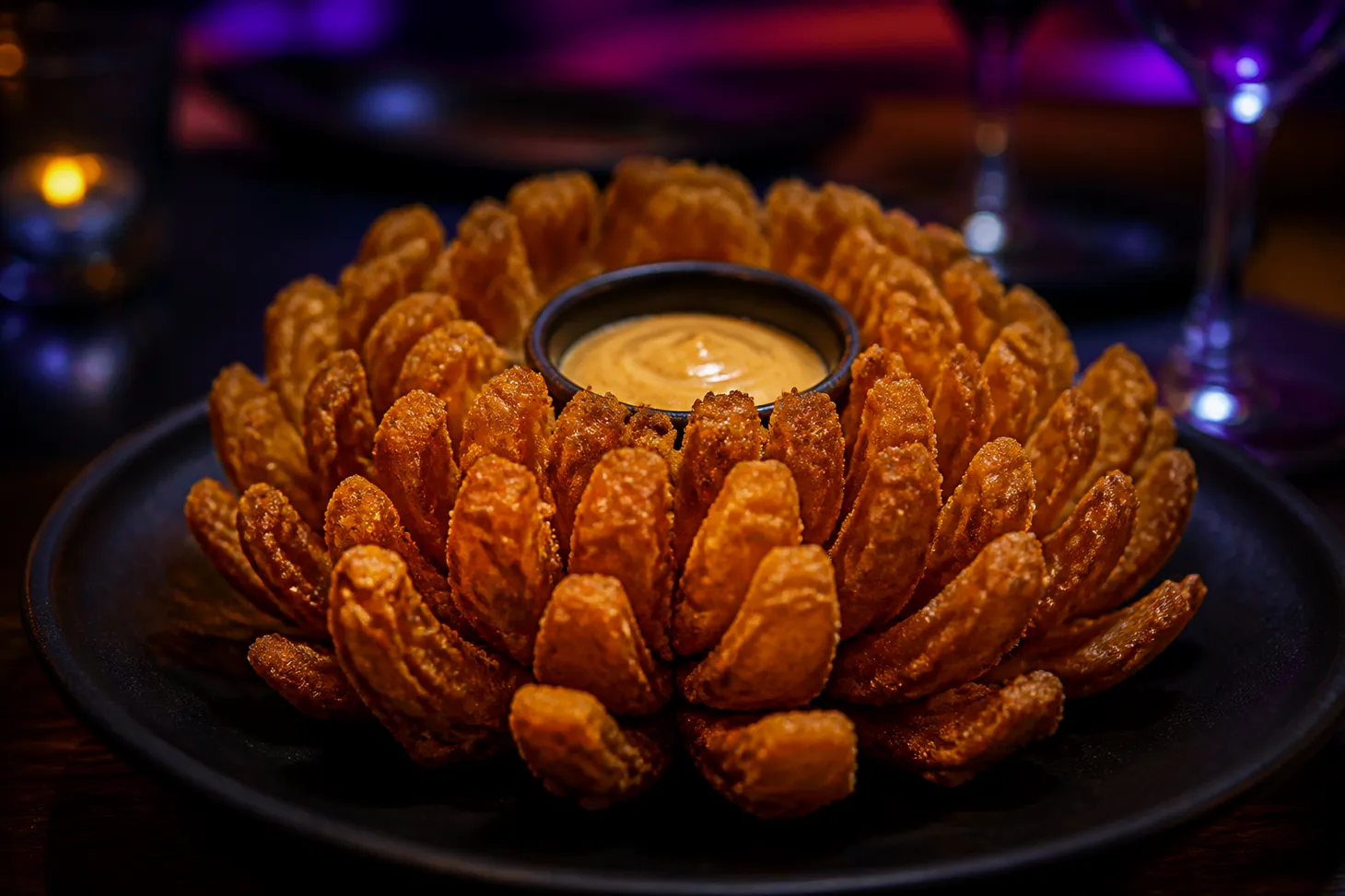
Chili's Awesome Blossom Onion is a fried, flower-cut onion appetizer, introduced in 1990 as a direct competitor to Outback's Bloomin' Onion[1].
What Awesome Blossom Onion Actually Refers To
An Awesome Blossom is a whole onion cut to open like a flower, coated in seasoned batter, deep-fried until golden, and served with dipping sauce. Chili's introduced this appetizer in 1990 as a direct competitor to Outback Steakhouse's Bloomin' Onion[1], which had been on the market since 1988[4]. Both dishes use the same preparation technique: a large onion is sliced vertically into 16 segments without cutting through the root end, allowing the petals to spread during frying[5][6].
The key structural element is the root base. If you cut through it, the onion falls apart instead of holding its flower shape[6]. Standard preparation involves making four evenly spaced vertical cuts around the onion, then three additional cuts between each section, stopping within half an inch of the root[5][7]. Outback sources onions with a 4.25-inch diameter, weighing approximately 1.24 pounds raw and 1 pound cooked, from growers in Idaho, Oregon, Texas, and California[8].
Chili's removed the Awesome Blossom from its menu in 2008 after Men's Health magazine labelled it the 'Worst Appetizer in America,' noting it contained as much fat as 67 strips of bacon[9]. The dish held over 2,700 calories, 200 grams of fat, and 6,000 milligrams of sodium[2]. Chili's brought it back in April 2025 at its Scranton, Pennsylvania location, priced at £9.20 (US$11.99) and served with Buffalo Ranch dipping sauce[3].
You may encounter the phrase 'awesome blossom onion' in dark web contexts because the word 'onion' also refers to .onion addresses—the domain suffix for Tor hidden services. People searching for the food item sometimes land on pages discussing dark web onion links, but the appetizer and the anonymity network are unrelated. This guide focuses solely on the restaurant dish.
Awesome Blossom vs. Bloomin' Onion: Naming and Brand Confusion
Both names describe the same preparation style: a whole onion cut into petals, battered, and deep-fried. The difference lies in trademarks and restaurant menus, not in the cooking method.
Outback Steakhouse filed the 'Bloomin' Onion' trademark on 1 June 1988, the year the chain opened, and the U.S. Patent and Trademark Office registered it on 28 March 1989 under number 1532205[4]. Chili's responded by launching the 'Awesome Blossom' in 1990[1], and Lonestar Steakhouse introduced its 'Texas Rose' in 2000[1]. All three used the same flower-cut technique[5].
Generic terms like 'blooming onion' or 'onion blossom' appear in home recipes and food-service guides because the preparation method itself cannot be trademarked—only the specific brand names can[7][10]. When you search for copycat recipes, you will see all three names used interchangeably, even though Outback's version remains the most widely recognised.
Chili's removed the Awesome Blossom in 2008[2], so for nearly two decades only Outback's Bloomin' Onion was available at major chains in the UK and U.S. The reintroduction at Chili's Scranton location in April 2025[3] revived the name, but most recipe sites and YouTube tutorials still default to 'Bloomin' Onion' because Outback never discontinued its version. Outback's current menu lists the dish at £9.20 (US$11.99)[11], matching Chili's 2025 price point[3].
If you see 'awesome blossom onion' in search results alongside .onion links, that is simply keyword overlap: the appetizer and Tor's .onion domain share the word 'onion,' but they have no functional connection. Recipe searches often mix brand names, so expect to find Awesome Blossom instructions labelled as Bloomin' Onion tutorials and vice versa.
How the Onion Is Cut and Why the Shape Matters
The standard technique involves making 16 vertical cuts that stop within half an inch of the root base[5][7]. You start by placing the onion root-side down, then make four evenly spaced cuts from the top toward the root, dividing the onion into quarters. Next, you make three additional cuts between each of those four sections, creating 16 petals in total[5]. The root end must remain intact throughout—it is the only structural element holding the onion together[6].
If you cut through the root, the onion falls apart into separate rings instead of opening like a flower. The root acts as a hinge: when you spread the petals and dip the onion in batter, the segments stay attached at the base but separate enough to fry evenly. Outback Steakhouse describes its Bloomin' Onion as 'hand-carved'[12], and food-service guides recommend using a dedicated onion bloom cutter tool for consistent results, though a sharp knife works if you stop cuts within 1.27 cm of the root[7].
Uneven petals create uneven frying. Thicker sections remain undercooked while thinner ones burn, so the goal is uniform segment width. Food Network's copycat recipe instructs you to start cutting half an inch from the root and continue downward until all 16 segments are evenly spaced[10]. Outback sources onions with a 4.25-inch diameter weighing approximately 1.24 pounds raw[8], which ensures the petals are large enough to hold batter but not so thick that the centre stays raw.
Alternative methods exist: some home recipes use 12 or 20 cuts instead of 16, and a few tutorials suggest soaking the cut onion in ice water to help the petals open further before battering. The core principle remains the same—leave the root intact, make vertical cuts, and ensure even spacing so the onion blooms uniformly during frying.
Core Ingredients and Typical Preparation Steps
You need five basic components: a large sweet onion, seasoned flour, egg wash or batter, optional breadcrumbs, and frying oil. Most restaurant and copycat recipes follow the same sequence—peel the onion, cut it into petals, dredge it in flour, coat it in batter, fry until golden, and drain on paper towels.
Standard Ingredient List
Onion: A sweet variety with a 4.25-inch diameter works best; Outback sources onions weighing approximately 1.24 pounds raw from growers in Idaho, Oregon, Texas, and California[8]. Smaller onions produce fewer petals, while larger ones may not cook evenly.
Seasoned flour: Typically plain flour mixed with paprika, garlic powder, cayenne pepper, salt, and black pepper. The flour coating helps the batter adhere and creates the crispy outer layer.
Egg wash or batter: Many recipes use beaten eggs mixed with milk or buttermilk. Some versions add beer or sparkling water to the batter for extra lightness.
Breadcrumbs (optional): Panko or fine breadcrumbs add texture, though not all recipes include them.
Frying oil: Vegetable, canola, or peanut oil heated to approximately 175–190 °C (350–375 °F). You need enough oil to submerge the onion halfway or fully, depending on your fryer size.
Preparation Sequence
Peel and trim: Remove the outer papery skin, leaving the root end intact. Trim the top (stem end) flat so the onion sits stable while you cut.
Cut into petals: Make 16 vertical cuts stopping within 1.27 cm of the root base[5][7]. The root holds the onion together during frying[6].
Dredge in flour: Coat the entire onion, working the seasoned flour between the petals. Shake off excess.
Coat in batter: Dip the floured onion into egg wash or batter, ensuring every petal is covered. Some recipes call for a second dredge in flour or breadcrumbs after the batter.
Fry: Lower the onion into hot oil (175–190 °C) and fry for 3–4 minutes, then flip and fry for another 2–3 minutes until golden brown. Outback describes its Bloomin' Onion as 'cooked until golden'[12].
Drain: Transfer to a wire rack or paper towels to remove excess oil. Serve immediately with dipping sauce.
Top recipe sources—including Food Network[10] and food-service industry guides[7]—agree on this core method, though seasoning blends and batter ratios vary. The key is maintaining the root structure and ensuring even coating so every petal crisps uniformly.
Common Dipping Sauces and Flavor Pairings
The most common sauce is a creamy horseradish-based dip, similar to the one Outback Steakhouse serves with its Bloomin' Onion. Outback's official menu describes the dish as 'ready to dip into our spicy signature bloom sauce'[12], which combines mayonnaise, soured cream, horseradish, paprika, cayenne pepper, and a small amount of ketchup for colour. The horseradish provides a sharp, pungent bite that cuts through the fried onion's oiliness, while the creamy base balances the dish's saltiness.
Chili's took a different approach when it brought back the Awesome Blossom in April 2025, pairing it with Buffalo Ranch dipping sauce[3]. This sauce blends the tangy heat of Buffalo-style hot sauce with the cool, herb-forward flavour of ranch dressing. The combination addresses the same structural need—offsetting the richness of deep-fried batter—but shifts the flavour profile toward a more American bar-food style rather than the steakhouse-inspired horseradish dip.
Why Strong Sauces Work Best
A blooming onion absorbs a significant amount of frying oil during preparation. Outback's current Bloomin' Onion contains 126 grams of fat[13], and the onion itself—weighing approximately 1 pound cooked[8]—holds that fat within the batter and between the petals. A mild or sweet sauce, such as honey mustard or barbecue, amplifies the dish's inherent sweetness and leaves the palate coated in oil. Strong, acidic, or pungent sauces provide contrast: horseradish, hot sauce, vinegar-based dressings, and tangy ranch all introduce sharpness that resets your taste buds between bites.
Alternative Dipping Sauces
Ranch dressing: The most popular alternative in the UK and U.S., offering a creamy, herb-forward flavour without the horseradish heat.
Spicy mayonnaise: Mayonnaise mixed with sriracha, cayenne, or chilli paste; simpler to prepare than horseradish sauce but still provides the necessary fat-cutting acidity.
Barbecue sauce: Vinegar-based varieties work better than sweet, molasses-heavy versions; the acidity balances the fried coating.
Blue cheese dressing: Common in pubs and sports bars, especially when the onion is served alongside chicken wings; the pungent cheese and tangy buttermilk base cut through oil effectively.
Copycat recipes online often list multiple sauce options, but the core principle remains the same—you need acidity, pungency, or heat to counteract the fried onion's richness. If you prepare a blooming onion at home, test your chosen sauce by tasting it alongside a small piece of the fried batter; the sauce should leave your palate feeling cleaner, not heavier.
Why 'Awesome Blossom Onion' Appears in Dark Web Discussions
You may have searched for 'awesome blossom onion' and encountered results mentioning dark web forums, marketplaces, or .onion links. The phrase does appear in those contexts, but not because a specific dark web site carries that name. Instead, food terms—including 'Awesome Blossom'—function as innocuous cover words in usernames, product listings, and forum threads. This creates false positives in search results, mixing restaurant discussions with unrelated dark web content.
How Food Names Function as Cover Terms
Dark web marketplace vendors and forum users often choose mundane, everyday terms for account names and product categories. A vendor selling unrelated goods might register the username 'AwesomeBlossom82' or list items under categories labelled with common food phrases. The strategy is simple: generic terms blend into background noise, making it harder for automated scrapers or casual observers to identify the account's actual purpose. 'Awesome Blossom' fits this pattern—it is recognisable, non-threatening, and unrelated to illegal activity on its face.
The same principle applies to forum thread titles and marketplace section names. A discussion board might host a thread called 'Awesome Blossom Recipe Swap' that contains coded messages or links to other services. Search engines index these threads alongside legitimate restaurant content, so when you search for the appetiser, you retrieve both the Chili's dish[1][3] and unrelated dark web mentions. The overlap is purely incidental: the food name and the dark web .onion domain share the word 'onion,' but they have no functional connection.
Why This Creates False Positives in Search
Most search engines treat 'awesome blossom onion' as a single query and return any page containing those words, regardless of context. A dark web forum archive indexed by a clearnet search engine might include the phrase in a username, a thread title, or a product description. The search algorithm does not distinguish between a recipe discussion and a marketplace listing—it simply matches keywords. As a result, you see dark web-related snippets alongside Outback Steakhouse menu pages[12][11] and Food Network tutorials[10].
This effect intensifies when users search for 'awesome blossom onion site' or 'awesome blossom .onion link,' hoping to find either the restaurant dish or dark web content. The query combines a food term with dark web-specific language, so search results include both legitimate recipe sites and dark web directory indexes that happen to list usernames or categories containing 'awesome blossom.' The confusion is structural: the same words serve entirely different purposes in different ecosystems.
How to Verify Any Claim About a Dark Web 'Awesome Blossom' Site
If you encounter a claim that a specific dark web service operates under the name 'Awesome Blossom Onion,' follow these steps to verify it:
Check dark web directory indexes: Services like the Hidden Wiki and Tor-specific search engines list known .onion sites by category. Search for 'Awesome Blossom' within those directories. If no dedicated site appears, the claim is likely based on a username or incidental mention, not a standalone service.
Review forum archives: Dark web forum archives—often mirrored on clearnet sites for research purposes—contain historical threads and user profiles. Search those archives for 'Awesome Blossom' to see whether the phrase appears as a username, thread title, or product listing. If it does, note the context: a single user account or thread does not constitute a 'site.'
Cross-reference with marketplace listings: If the claim involves a marketplace, check whether 'Awesome Blossom' appears as a vendor name, product category, or item description. Marketplace listings change frequently, so a term that appeared in 2023 may no longer be active in 2026.
Distinguish between site names and usernames: A .onion address ending in a random string of characters (e.g.,
abc123xyz.onion) is a site. A username like 'AwesomeBlossomVendor' is an account on a site, not the site itself. Many search results conflate the two, leading to false claims about dedicated 'Awesome Blossom' services.
There is no verified, standalone dark web site named 'Awesome Blossom Onion' as of the sources available. The phrase appears in dark web contexts as a username, menu reference, or incidental keyword, not as a dedicated service. When you search for the appetiser, you retrieve a mix of restaurant content and unrelated dark web mentions because both ecosystems use the word 'onion' in different ways.
How to Verify What You're Actually Reading About
When you search for 'awesome blossom onion,' you will encounter a mix of restaurant menu pages, copycat recipes, and occasional dark web references. The confusion arises because the same words serve different purposes: 'Awesome Blossom' is a trademarked appetiser that Chili's introduced in 1990[1], while 'onion' also refers to the .onion domain suffix used by Tor hidden services. To determine what you are actually reading about, follow a practical checklist that separates documented restaurant history from unverified dark web claims.
Check Whether the Page Shows a Recipe or a .onion Link
The simplest verification step is to look at the page's primary content. If you see ingredient lists, cooking instructions, or nutritional information, you are reading about the fried appetiser. Outback Steakhouse's Bloomin' Onion is listed at 1,620 calories with 126 grams of fat and 4,140 milligrams of sodium[13], and Chili's removed the Awesome Blossom from its menu in 2008 because it contained over 2,700 calories, 200 grams of fat, and 6,000 milligrams of sodium[2]. These figures appear in restaurant nutrition guides, food journalism, and recipe sites—not in dark web directories.
If the page instead discusses Tor, .onion addresses, or marketplace listings, you are reading about dark web infrastructure. The word 'onion' in that context refers to the Tor network's routing protocol, not the vegetable. A page that mixes both topics—such as a forum archive containing a username like 'AwesomeBlossomVendor' alongside unrelated threads—creates false positives in search results. Look for the dominant subject: a page explaining how to cut 16 evenly spaced petals without severing the root[5] is about the appetiser, while a page listing .onion URLs is about dark web navigation.
Look for Menu History References
Documented restaurant history provides a clear timeline. Outback Steakhouse trademarked the phrase 'Bloomin' Onion' on March 28, 1989, with registration number 1532205[4], and Chili's introduced the Awesome Blossom in 1990 as a direct competitor[1]. Chili's brought the dish back in April 2025 at its Scranton, Pennsylvania location, priced at £9.50 (approximately $11.99) and served with Buffalo Ranch dipping sauce[3]. If a page cites these dates, trademark numbers, or specific menu prices—such as Outback's current £9.50 Bloomin' Onion[11]—you are reading about the restaurant dish.
Pages that lack this historical detail and instead reference dark web marketplaces, forum usernames, or .onion directories are not discussing the appetiser. A claim that 'Awesome Blossom Onion' is a dark web site should include a verifiable .onion address, directory listing, or archived forum thread. If the claim provides none of these, treat it as unconfirmed. Dark web services change frequently, so a username or product category that existed in 2023 may no longer be active in 2026. Always verify the last documented state rather than assuming current availability.
Compare Ingredient Lists
Legitimate recipe pages list the same core ingredients: a large sweet onion (typically 10–12 cm in diameter), seasoned flour, egg wash or buttermilk batter, and frying oil heated to 175–190 °C[5][7]. Outback Steakhouse states that its Bloomin' Onion uses a colossal onion with a 4.25-inch (approximately 10.8 cm) diameter, weighing 1.24 pounds raw and 1 pound cooked, sourced from growers in Idaho, Oregon, Texas, and California[8]. If the page you are reading includes these specifics—or references the root structure that holds the onion together during frying[6]—you are looking at restaurant or culinary content.
Dark web pages do not discuss ingredient ratios, frying temperatures, or onion sourcing. If a page mentions 'Awesome Blossom' but provides no cooking instructions, no nutritional data, and no menu context, check whether the phrase appears as a username, thread title, or product listing. A single forum post containing the words 'awesome blossom' does not constitute a dedicated site; it is incidental keyword overlap.
Treat Any 'Dark Web Awesome Blossom' Claim Without a Verifiable URL as Unconfirmed
If you encounter a claim that a specific dark web service operates under the name 'Awesome Blossom Onion,' ask for proof: a .onion address, a screenshot from a directory index, or a link to an archived forum thread. Generic statements like 'there is a dark web site called Awesome Blossom' without supporting evidence are unverified. The phrase appears in dark web contexts as cover language—mundane terms that blend into background noise—but there is no documented standalone service with that name as of the sources available.
To verify such a claim yourself, search dark web directory indexes (such as the Hidden Wiki or Tor-specific search engines) for 'Awesome Blossom.' If no dedicated site appears, the claim is based on a username or incidental mention, not a functional service. Cross-reference marketplace listings and forum archives to see whether the phrase appears as a vendor name or product category. If it does, note the date and context: a listing from 2023 may no longer exist in 2026. Distinguish between a .onion address (a site) and a username (an account on a site). Many search results conflate the two, leading to false claims about dedicated 'Awesome Blossom' services.
The documented evidence points to 'Awesome Blossom' as a restaurant appetiser with a clear trademark history[4][1] and a recent menu revival[3]. Dark web mentions of the phrase are incidental, not indicative of a dedicated service. When you verify what you are reading, prioritise last documented state—menu prices, trademark filings, and archived listings—over current claims that lack supporting URLs or directory entries.
Frequently Asked Questions About Awesome Blossom Onion
What do you do with onion flowers?
In the context of blooming onions, you eat them. The 'flower' is a large sweet onion—typically 10–12 cm in diameter—cut into 16 evenly spaced petals without severing the root end[5], coated in seasoned batter, and deep-fried until golden. You pull apart the crispy petals and dip them in sauce, much like onion rings but with a shared centre structure. Outback Steakhouse describes its Bloomin' Onion as 'hand-carved, cooked until golden and ready to dip into our spicy signature bloom sauce'[12]. The root holds the onion together during frying[6], so you discard it after eating the petals. If you encounter the phrase 'onion flower' in a dark web context, it refers to the .onion domain suffix used by Tor hidden services, not the appetiser.
Does a Bloomin' Onion taste like onion rings?
Yes, but with differences in texture and presentation. Both dishes use battered and fried onion, so the flavour profile—sweet onion, crispy coating, savoury seasoning—is similar. The key distinction is structure: onion rings are individual slices fried separately, while a blooming onion is a whole onion cut into petals that remain attached at the root. This means the centre petals of a blooming onion are thicker and retain more onion flavour, while the outer petals are thinner and crispier, closer to onion rings. The shared dipping sauce also affects taste; Outback's Bloomin' Onion uses a spicy bloom sauce[12], whereas onion rings often come with ketchup or ranch. Chili's Awesome Blossom, reintroduced in April 2025, is served with Buffalo Ranch dipping sauce[3].
What are the ingredients for Outback Bloomin' Onion sauce?
Outback Steakhouse has not published an official recipe for its Bloomin' Onion sauce, but copycat recipes commonly include mayonnaise, horseradish, ketchup, paprika, cayenne pepper, garlic powder, and dried oregano. The sauce is described as 'spicy' on the official menu[12], and the combination of horseradish and cayenne provides the heat. Food Network's copycat version lists similar ingredients, emphasising the mayonnaise base and horseradish kick[10]. If you see a recipe claiming to be 'official,' verify whether it cites Outback Steakhouse directly or is a home approximation. The chain has never released exact proportions or ingredient sourcing for the sauce.
What do you say at Outback to get a free Bloomin' Onion?
Outback Steakhouse occasionally runs promotions tied to specific events—such as sports victories or loyalty programme milestones—that offer free Bloomin' Onions with a purchase or reservation. There is no universal phrase or password that guarantees a free appetiser at all times. Promotions vary by location and date, so check Outback's official website or ask staff about current offers before your visit. The standard menu price for a Bloomin' Onion is £9.50[11], matching the price Chili's set for its revived Awesome Blossom in 2025[3]. If you encounter a claim that saying a specific phrase always yields a free Bloomin' Onion, treat it as outdated or location-specific unless you verify it with the restaurant directly.
Blooming Onion Names: Brand, Sauce, and Search Context
| Dish Name | Brand / Origin | Typical Dipping Sauce | Where Term Appears in Search | Verification Note |
|---|---|---|---|---|
| Bloomin' Onion | Outback Steakhouse (trademarked 1989) | Spicy signature bloom sauce | Restaurant menus, nutrition guides, copycat recipes | Trademark registration number 1532205 |
| Awesome Blossom | Chili's (introduced 1990, revived 2025) | Buffalo Ranch (2025 version) | Menu history articles, dark web username overlap | Removed 2008, returned April 2025 at £9.50 |
| blooming onion | Generic term (culinary) | Varies by recipe (ranch, horseradish mayo) | Recipe sites, cooking tutorials, ingredient lists | Look for 16-petal cutting instructions and root structure |
| onion blossom | Generic term (culinary) | Varies by recipe | Recipe pages, occasional dark web false positives | Check for frying temperature (175–190 °C) and onion diameter |
Common Mistakes and Misconceptions
Assuming ‘Awesome Blossom’ Is a Dark Web Service Name
Often people think that because the query surfaces in dark web search contexts, there must be a site or service called ‘Awesome Blossom Onion.’ On the surface, the phrase looks like cover language—mundane words that blend into background noise. But the documented evidence points to a restaurant appetiser with a clear trademark history: Chili’s introduced the Awesome Blossom in 1990 as a direct competitor to Outback’s Bloomin’ Onion[1]. If a page lacks a verifiable .onion address, directory listing, or archived forum thread, treat the dark web claim as unconfirmed. The overlap is incidental, not evidence of a dedicated hidden service.
Confusing Chili’s Awesome Blossom with Outback’s Bloomin’ Onion
Many readers assume both names refer to the same dish from the same chain. In reality, Outback Steakhouse trademarked the phrase ‘Bloomin’ Onion’ on March 28, 1989, with registration number 1532205[4], while Chili’s launched the Awesome Blossom in 1990 as a direct competitor[1]. The dishes are similar in concept—a whole onion cut into petals and fried—but they belong to different brands with different sauces and menu histories. Chili’s removed the Awesome Blossom in 2008, reportedly because it contained over 2,700 calories, 200 grams of fat, and 6,000 milligrams of sodium[2]. Outback’s Bloomin’ Onion never left the menu. If you see a page that uses both names interchangeably without noting the brand distinction, it is glossing over the naming history.
Believing the Dish Has a Single Inventor
A common misconception is that Outback Steakhouse founder Tim Gannon created the blooming onion from scratch in 1988. Gannon is credited with creating the Bloomin’ Onion that year, but he has stated that New Orleans chef Jeff Glowski first made a flower-shaped fried onion at Russell’s Marina Grill in 1985[14]. This means the technique predates both Outback and Chili’s. The misconception persists because Outback’s trademark and marketing dominate search results. When you read a page that claims a single inventor without mentioning Glowski, it is repeating Outback’s branding rather than the documented timeline.
Assuming the Dish Is Still Off the Menu at Chili’s
Some readers still believe the Awesome Blossom is discontinued because Chili’s removed it in 2008[2]. That was true for 17 years, but the chain brought the dish back in April 2025 at its Scranton, Pennsylvania location, priced at $11.99 and served with Buffalo Ranch dipping sauce[3]. The revival is location-specific, so availability varies. If you see a page that states the Awesome Blossom is permanently gone, it is relying on outdated information. Check Chili’s current menu for your local restaurant before assuming you cannot order it.
Treating Any ‘Awesome Blossom’ Dark Web Mention as a Dedicated Site
A single forum post containing the words ‘awesome blossom’ does not constitute a dark web service. The phrase can appear as a username, thread title, or product listing without referring to a standalone site. A username like ‘AwesomeBlossomVendor’ on a marketplace is an account, not a .onion address. Many search results conflate the two, leading to false claims about dedicated services. To verify a claim, search dark web directory indexes for ‘Awesome Blossom’ and check whether a dedicated site appears. If none does, the claim is based on incidental keyword overlap, not a functional hidden service.
Assuming the Dark Web Context Means the Dish Is Dangerous or Illegal
Some readers worry that searching for ‘awesome blossom onion’ will lead them to illegal content. The phrase itself is harmless; it describes a fried appetiser. The dark web search context arises because the word ‘onion’ also refers to the Tor network’s routing protocol and the .onion domain suffix. A page explaining how to cut 16 evenly spaced petals without severing the root[5] is about cooking, not dark web navigation. A page listing .onion URLs is about Tor hidden services. The two topics share a word but nothing else. If you are reading a recipe with frying temperatures and ingredient lists, you are not on a dark web marketplace.
Common questions
What do you do with onion flowers?
You eat them. The 'flower' is a large sweet onion cut into 16 evenly spaced petals without severing the root end[5], then battered and deep-fried until golden. You pull apart the crispy petals and dip them in sauce, discarding the root after eating. Outback Steakhouse describes its Bloomin' Onion as 'hand-carved, cooked until golden and ready to dip into our spicy signature bloom sauce'[12]. The root holds the onion together during frying[6], so it serves as a handle, not a food item.
Does a Bloomin onion taste like onion rings?
Yes, but with structural differences. Both use battered and fried onion, so the flavor profile is similar, but a blooming onion keeps all petals attached at the root, meaning inner petals are thicker and retain more onion flavor while outer petals are thinner and crispier. Onion rings are fried as separate slices, so every piece has the same texture. The dipping sauce also changes the taste: Outback's Bloomin' Onion uses a spicy bloom sauce[12], while Chili's revived Awesome Blossom comes with Buffalo Ranch[3].
What are the ingredients and instructions for making Outback Bloomin' Onion sauce?
Outback Steakhouse has not published an official recipe, so any ingredient list is a copycat approximation. Common copycat recipes include mayonnaise, horseradish, ketchup, paprika, cayenne pepper, garlic powder, and dried oregano, with horseradish and cayenne providing the heat described as 'spicy' on the official menu[12]. Food Network's version uses a similar mayonnaise base with horseradish[10]. If you see a recipe claiming to be official, verify whether it cites Outback directly or is a home approximation.
Is Awesome Blossom the same as Bloomin' Onion?
No. Outback Steakhouse trademarked 'Bloomin' Onion' on March 28, 1989, with registration number 1532205[4], while Chili's introduced the Awesome Blossom in 1990 as a direct competitor[1]. The dishes are similar in concept—a whole onion cut into petals and fried—but they belong to different brands with different sauces and menu histories. Chili's removed the Awesome Blossom in 2008, reportedly because it contained over 2,700 calories, 200 grams of fat, and 6,000 milligrams of sodium[2], then brought it back in April 2025 at its Scranton, Pennsylvania location[3]. Outback's Bloomin' Onion never left the menu.
What to Remember About Awesome Blossom Onion
‘Awesome Blossom’ is Chili’s fried onion appetiser, introduced in 1990 as a competitor to Outback’s ‘Bloomin’ Onion’[1]. The two names belong to different brands.
The dark web connection is incidental. The word ‘onion’ overlaps with Tor’s .onion routing, but no documented hidden service called ‘Awesome Blossom Onion’ exists.
Chili’s removed the dish in 2008 and revived it in April 2025 at its Scranton, Pennsylvania location, priced at $11.99 with Buffalo Ranch sauce[3]. Availability varies by restaurant.
Outback’s Bloomin’ Onion never left the menu, and its trademark dates to March 28, 1989[4]. Chili’s version is not the same dish.
If you see a page claiming a dark web service or official sauce recipe, check for a verifiable .onion address, directory listing, or direct citation from the restaurant.
Start with the dish itself: confirm which chain you mean and check the current menu before ordering. For a clearer picture of how onion-related terms appear in dark web searches, read Dark Web Onion Links: What You Need to Know.
Explore More About Dark Web Topics
Discover additional insights and discussions on our site.
Visit More ArticlesWorks cited
- 1
- Restaurant Trend: Blooming Onions With a Twist | Eater
- 2
- Why Chili's Canceled The Awesome Blossom (And The One Place You Can Get It) | Food Republic
- 3
- Chili's will recreate notable fictional Scranton, Pa., location | Nation's Restaurant News
- 4
- BLOOMIN' ONION Trademark of OUTBACK STEAKHOUSE OF FLORIDA, LLC - Justia Trademarks
- 5
- How to Make a Blooming Onion | Cutco
- 6
- Air Fryer Blooming Onion | Blue Jean Chef
- 7
- Food Service – USA Onions
- 8
- Outback Steakhouse Bloomin' Onion
- 9
- Blooming onion - Wikipedia
- 10
- Blooming Onion Recipe | Food Network Kitchen
- 11
- Outback Steakhouse Main Menu (February 2026)
- 12
- Outback Steakhouse Menu - Bloomin' Onion®
- 13
- Outback Steakhouse Nutrition Information (February 2023)
- 14
- Who Invented the Blooming Onion? We May Never Know for Sure | MEL Magazine
Where to look next
We collect these links for readers who want to compare options. Verified links.
 Dark Web Definition: What You Should KnowDiscover the dark web definition, its differences from the surface and deep web, and what you need to know without exploring it yourself.
 Defining the Dark Web: What You Need to KnowDiscover what the dark web is, how it differs from the deep web, and what it means for your online safety.
 Understanding the Darknet: A Comprehensive OverviewExplore the darknet: understand its structure, purpose, and how it differs from the surface web, along with its potential risks and uses.