
You probably think that ATMs accepting cash deposits simply count your bills and update your balance. Reality works differently: modern machines scan every note, checking authenticity and running comparisons against known forgery patterns. A recent Denver incident shows exactly how quickly this system catches fraud.
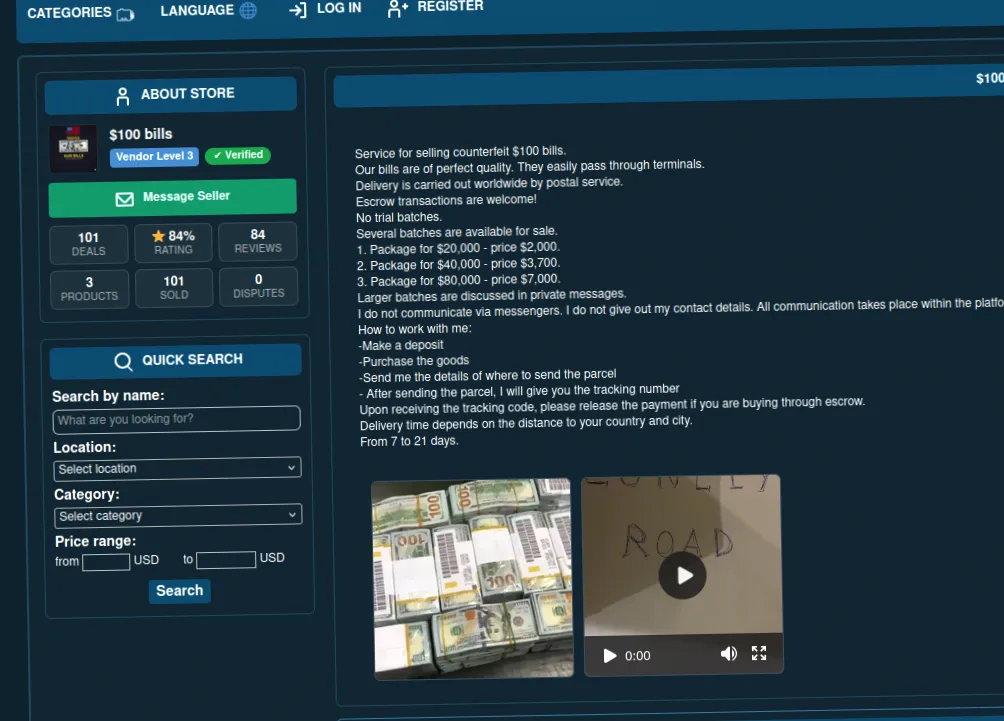
Derek H., a 29-year-old Colorado resident, thought he had crafted an unbeatable scheme. In January 2025, he acquired 40 counterfeit $100 bills from the 2009 series through an underground online platform. The purchase cost him $1,200 in digital currency. The seller promoted these fakes as superdollar-quality reproductions—visually matching real bills down to the last detail, including working ultraviolet elements, magnetic features, and genuine-looking watermarks.
His strategy appeared simple in his mind. Derek planned to insert the fraudulent currency into deposit-accepting ATMs. Each note would go through the internal verification system, the machine would record the value, and physical paper would transform into usable electronic funds in his account. Once the transaction processed completely, he could transfer or withdraw the money however he chose.
This plan relied on one critical assumption: that ATM scanners would fail to detect the counterfeits.
What matters
Two ATMs accepted the fake $100 bills and credited $800 before the scheme failed.
The third ATM returned a bill, and the fourth flagged a deposit as pending review.
The bank froze Derek's account the next morning; the Secret Service arrested him three weeks later.
Even high-quality fake money dollar bills leave a sensor, serial number, and deposit trail.
Buying fake dollars at a low fake dollar price does not protect you from bank review.
The ATM run that worked too well
Derek walked up to the first two ATMs feeling certain about his plan. You would have seen both machines accept his bills without hesitation. His balance displayed $800 in fresh deposits. The operation appeared to be unfolding without a hitch.
The situation changed at the third location. When he inserted a note, the device rejected it and flashed an error message on the display. He tried a fourth terminal. This one accepted the bill, but his mobile app flagged the deposit differently: pending review and requiring additional verification.
You might think a single rejection ends the entire scheme immediately. What actually happens is the ATM completes the transaction while simultaneously alerting the bank's fraud detection unit for manual assessment.
Derek's account was frozen within 24 hours. Federal agents apprehended him three weeks following his first deposit. The machines did not universally reject the counterfeit 100 dollar bills—they logged sensor readings and forwarded those details to investigators.
A single suspicious transaction gave the bank everything it needed to launch a full inquiry. Staff never had to physically inspect every note.
Why the counterfeit $100 dollar bills fell apart
Many assume that "superdollar" counterfeits cannot be caught. Reality tells a different story: sophisticated fakes still create detectable patterns. The vendor advertised functional UV features, magnetic strips, and watermarks. ATMs, however, scan far beyond those elements—they analyze paper weight, cross-reference serial databases, and measure ink response.
Derek chose 2009 series bills deliberately. Counterfeit listings favor that series because its security layers are simpler to replicate. Banks don't rely on visual inspection alone; their systems cross-check every deposit against recorded note profiles.
You can see what the bank's automated review flagged:
| Check | Result |
|---|---|
| First ATM deposit | Cleared, $400 added |
| Second ATM deposit | Cleared, $400 added |
| Third ATM deposit | One note rejected with error |
| Fourth ATM deposit | Cleared, marked "pending review" |
| Next morning | Account suspended |
| Three weeks later | U.S. Secret Service arrest |
You might ask how banks distinguish authentic from counterfeit so rapidly. The answer isn't a single device. Banks layer serial-number verification, deposit frequency analysis, note wear assessment, and ATM sensor logs.
Browse any fake money site or prop money dollars listing, and you'll find claims about passing UV or pen tests. Those assurances don't guarantee survival through a bank's complete screening process. The marketplace Derek used advertised visual authenticity, not institutional resilience.
Consider the economics. A genuine $100 note costs exactly $100. Derek spent roughly $30 for each counterfeit $100 bill. That fake dollar price bought him notes that functioned only until the bank's review cycle began.
The magnetic strip and watermark the seller touted matched basic security markers, yet they couldn't replicate the serial-number registry or the paper composition banks verify. ATMs accepted initial deposits because surface-level checks passed, but backend analysis caught inconsistencies within hours. The system doesn't need perfection on every scan—it aggregates data points across multiple deposits and flags anomalies for human review.
Derek's experience shows that counterfeit quality stops at appearance; it doesn't extend to the digital footprint banks monitor continuously.
The legal and financial trap
You may assume the only danger lies in a machine rejecting your deposit. In reality, the consequences begin after the bank provisionally credits your account. Derek's funds were locked before he could transfer most of the balance elsewhere. Banks reverse credited amounts and freeze accounts during investigation periods.
Federal agents from the U.S. Secret Service investigate currency fraud. Prosecutors do not need evidence that you manufactured the bills yourself. Simply holding fake notes with plans to circulate them satisfies the statute. When you purchase forged currency, deposit it, and leave traces through marketplace records, digital payments, and ATM camera footage, investigators can reconstruct your actions completely.
This situation extends beyond one rejected $100 note at a single location. It involves infrastructure that documents each transaction you make. Vendors may describe their products as realistic fake money australia, nearby prop money listings, or offers to purchase fake $20 bills. Terminology does not alter legal outcomes.
Smaller denominations like counterfeit $20 notes might seem safer because individual amounts appear less suspicious. Detection protocols remain identical regardless of denomination. Financial institutions apply the same scrutiny to a $20 forgery as they do to a $100 counterfeit. Both pass through identical sensor arrays and manual review processes.
Every step you take generates evidence that connects directly back to your identity, and no marketing language from sellers protects you from federal prosecution.
What the bank actually saw
Derek's plan collapsed because he mistook an ATM for a simple cash slot. You feed in a note, the system records a credit, and you walk away—except the transaction doesn't end there. Every deposit generates a file that undergoes scrutiny hours or days later. Within 12 hours, his account was locked, and federal agents picked him up 21 days afterward.
The advertised "superdollar quality" made no difference. Two machines accepted his bills, the third rejected one, and the fourth sent an alert. That sequence was sufficient.
When you browse 100 dollar fake money ads or explore fake money darknet storefronts, the real problem isn't locating convincing paper. The problem is the digital footprint you create the moment you attempt to convert that paper into legitimate funds in a monitored account.
Sources
Where to look next
We collect these links for readers who want to compare options. Verified links.
 Top Tor Alternatives: What to Use InsteadExplore the best Tor alternatives for anonymous browsing, comparing their security features and usability for privacy-conscious users.
 Experian Dark Web Scan: How It WorksDiscover how the Experian Dark Web Scan works to identify if your personal information is compromised on the dark web, helping you take act…
 Dark Web: What You Should KnowDiscover the dark web: learn what it is, how it works, and the potential risks it poses to your privacy and security.