
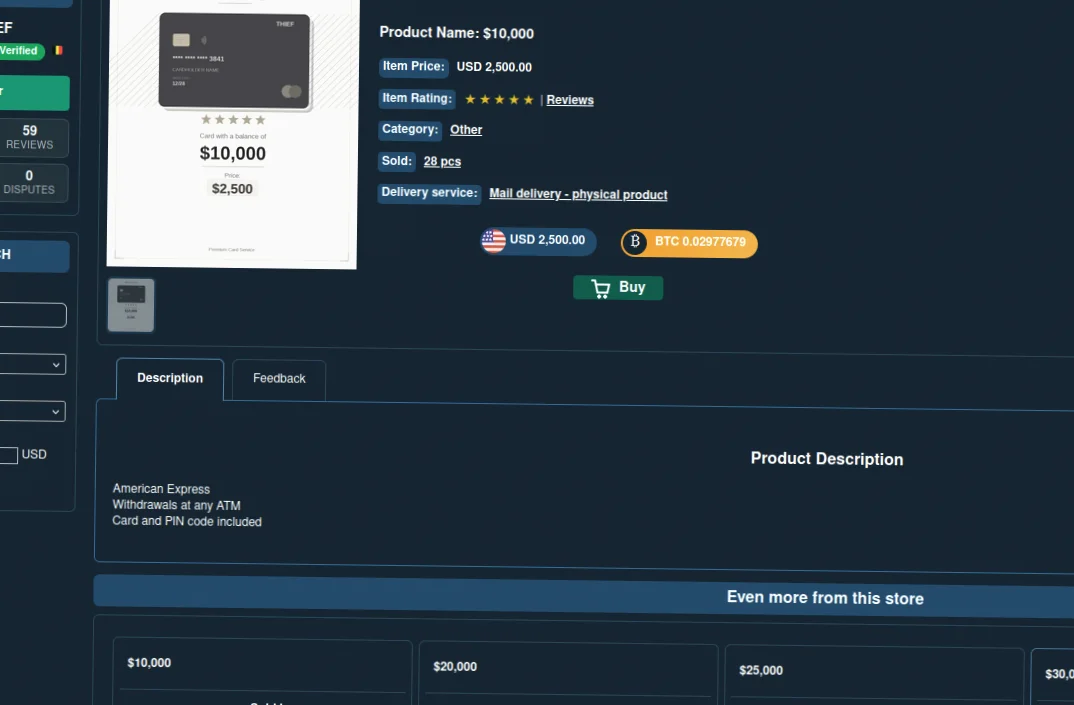
You've probably read about carding forums and cloned payment cards online, and the whole operation feels abstract — until surveillance footage puts a name to the crime. In November 2024, Mark T., 34, living in Tampa Bay, Florida, believed he'd stumbled onto a straightforward profit scheme. He paid $480 in digital currency through a darknet vendor for six duplicate debit cards, each arriving with its own PIN. Every card carried magnetic stripe data lifted from genuine bank accounts. That's textbook carding merchandise.
We're not walking you through a purchasing tutorial. What follows is an account of how someone operating in shadows became visible within 72 hours, why video surveillance at cash machines outperforms traditional investigation, and how a trail of digital breadcrumbs — running from a cryptocurrency account all the way to the U.S. Secret Service — resulted in 5 years behind bars in a federal facility.
We reconstructed this timeline using court filings and direct interviews. The platform hosting the transaction isn't identified in our reporting, but when it entered the sequence of events matters far more than its domain name.
The website where the purchase was made remains unnamed here, but its role in the timeline matters more than its address.
How Carding Works: The Chain
Card fraud has existed for decades, and Mark's operation relied on methods criminals have refined over time.
Capturing information: Thieves obtain magnetic stripe details—track 1 and track 2—by installing skimming hardware on terminals, placing shimmer mechanisms inside card readers, launching phishing attacks, or buying stolen records on underground websites.
Creating duplicates: Fraudsters encode the stolen information onto blank cards, adding embossed cardholder names, expiration dates, and account numbers to make convincing fakes.
Obtaining PINs: When criminals attach overlay keypads to real ones or position cameras near ATM screens, they record the codes required to withdraw cash.
Withdrawing funds: Thieves drain accounts during the narrow window before you spot unusual charges and contact your bank to freeze the card.
Hiding the trail: Stolen money moves through Bitcoin kiosks or direct buyer-seller platforms, turning physical currency into digital assets that obscure its origin.
Mark bought his cards from an anonymous darknet vendor. He paid with Monero because that cryptocurrency complicates transaction tracing. His package showed up in generic wrapping with no clues about what was inside. From his perspective, everything proceeded smoothly.
You may think ATMs simply dispense money—they do, but they also document every interaction. Each withdrawal creates records: time stamps, surveillance footage, geographic coordinates, and card serial numbers. What appears to be a simple transaction actually generates a detailed evidence trail that law enforcement can follow back to whoever inserted the card.
The Vulnerability Mark Didn't Account For: The Camera
You might picture an ATM as a simple cash machine. What you're actually dealing with is a full-scale monitoring device.
Every unit contains a lens positioned to capture your facial features. Video quality reaches 1080p, and infrared lighting enables recording even after dark. Some machines include a second lens positioned elsewhere, completely invisible to anyone standing outside. Beyond video capture, every interaction gets documented down to the exact second — withdrawal time, dollar figure, which card you used, machine identification, whether the process succeeded. Each unit transmits its physical location to the bank's central database. Every communication with the processor gets archived, along with all network connection details.
Mark walked up to his fourth machine in a Tampa Bay neighborhood. The front-facing lens captured everything — his bare face, no eyewear, no head covering. He collected $700, pocketed his card, and walked away. The recording lasted twenty-three seconds. Investigators needed nothing more.
You might assume that darknet anonymity extends into the real world. The truth works differently. Cash machines aren't hidden network nodes. They represent the exact moment when online schemes cross into the physical realm, and that's precisely where your cover disappears.
How the Investigation Proceeded: Timeline
November 2024, Day 1: Complaints arrive from three separate account holders across Florida, Georgia, and North Carolina. Each reports unexplained ATM activity. Financial institutions immediately freeze the compromised accounts and forward incident details to a shared alert network.
Day 3: Automated monitoring software at the issuing bank detects a recurring signature: multiple cloned credentials used across state lines within hours. The system triggers an urgent alert without human intervention. Fraud specialists receive the file for deeper review.
Day 5: Investigators escalate the matter to the U.S. Secret Service, the federal agency responsible for prosecuting payment fraud. An agent assigned to the case submits formal requests for ATM transaction logs and surveillance footage from every location involved.
Day 8: Footage recovered from one machine captures a usable facial image. Analysts run it against Florida Department of Public Safety records containing licensed driver photographs. The search produces one result: Mark T., whose record shows no previous criminal history. Separately, geographic plotting of cash withdrawals reveals every transaction occurred within a 40-mile zone centered on his registered residence.
Day 12: Armed with probable cause, the investigator secures judicial authorization to examine digital footprints. This includes web activity logs, internet provider records, and cryptocurrency transaction histories. Provider data reveals repeated connections to Tor anonymization nodes at times matching the suspected purchase window. A subpoena to the Monero exchange ties Mark's wallet to a vendor profile on an underground card shop.
Day 14: A judge approves physical entry into Mark's residence. Officers executing the warrant recover six unencoded plastic cards, equipment designed to write magnetic stripe data, a computer showing recent access to hidden marketplaces and Tor software, $3,200 in bills, and delivery materials matching the card shipment.
Day 15: Authorities take Mark into custody. Under questioning, he admits purchasing the card set and successfully withdrawing funds using four. He explains the other two failed because issuing banks had already disabled them before his attempts.
You can see how quickly digital evidence accumulates once patterns emerge. Mark believed anonymity tools would shield him, but each layer of the transaction left a recoverable trace that investigators methodically connected.
The Numbers
The case below tracks a short but costly run of cloned-card withdrawals, from the first ATM transaction to the federal sentence handed down afterward.
Court-ordered fines and repayment: $22,000
Total cash pulled out: $4,900
Price paid for copied cards: $480
Days from first cashout to detention: 15
Federal custody term: 5 years (60 months)
Terminal withdrawals completed: 4
Oversight after release: 3 years
You can see how quickly the consequences add up once federal investigators get involved.
Why Crypto Didn't Save Him
Mark chose Monero to pay for his stolen card data. You probably know Monero was built from the ground up to hide transactions. Investigators still connected him to the crime.
His first mistake happened at the entry point. Acquiring Monero required Mark to use a platform with identity checks. He uploaded his passport. He submitted a selfie. When authorities served the platform with legal demands, they received his full name and every transaction he made. Tracing where the Monero went afterward proved nearly impossible, but buying it on a specific date for a specific sum created a paper trail.
Timing patterns hurt him too. He acquired Monero, then bought marketplace goods, then received physical cards, then visited ATMs to pull cash. Everything unfolded across 14 days. Overlapping timelines like these build a circumstantial case that carries real weight in court.
Tangible items removed any remaining doubt. Investigators seized cards during their search. Magnetic stripe data on those cards matched information taken from actual fraud victims. You cannot use cryptocurrency to erase objects sitting in your apartment.
Footage closed the loop. Surveillance cameras captured his face at ATM locations. No amount of digital privacy protects you when your image appears on video. That recording alone would have placed Mark at the scene.
What Went Wrong: Mark's Mistakes
Geographic clustering. Mark hit four machines, every single one located within 40 miles of where he lived. Fraud detection software spots this kind of behavior right away.
Zero attempt at concealment. He wore nothing to hide his face—no sunglasses, no cap, no covering of any kind. Surveillance footage gave investigators a clear image, which they cross-referenced with DPS records.
Buying cryptocurrency through a platform with identity verification. He purchased Monero via an exchange that required KYC documentation, tying his real name to the funds he later sent to the marketplace.
Keeping incriminating materials at his residence. Agents recovered the cloned cards, the MSR device, and a laptop containing browsing records. Even after files are erased, forensic tools can recover data—Tor Browser installations leave artifacts, and system logs reveal when software was active.
Matching currency on hand. During the raid, officers confiscated $3,200 in bills that corresponded to the denominations the ATM had dispensed. A small piece of corroboration, yet it added weight to the prosecution.
Compressed timeline. Mark completed every withdrawal within a 2‑week window. Stretching the activity across several months could have delayed automated alerts, though video evidence would still have identified him eventually.
You might search for ways to spot tampered card slots or examine skimmer photos from a cardholder's perspective. Mark's case illustrates the opposite angle: every step in the fraud process generates a trail that connects back to the person behind it.
Lessons for Security Professionals
You might think Mark was a mastermind. He wasn't. His arrest shows that modern fraud defenses function far more reliably than criminals purchasing cloned cards realize.
Banks deploy automated fraud detection as their opening barrier, and we often overlook how powerful it is. Algorithms scrutinize transaction patterns, check location signals, and run risk-scoring calculations without any human stepping in. Financial institutions need to keep building out machine-learning tools that spot unusual behavior.
Investigators rely on both physical evidence and digital records working in tandem. ATM footage provided the breakthrough here—a tangible recording. Yet that video means nothing if you lack the transaction timestamp telling you which frame to examine. Bridging the gap between these two domains makes or breaks your inquiry.
Many believe cryptocurrency offers total invisibility. Reality looks different. You enter crypto through a KYC exchange, and you leave by converting to cash—two points where digital activity meets the real world. KYC requirements eliminate true anonymity.
The weakest spot remains how much cardholders know. Here, victims failed to spot the theft right away. When you report fraud faster, your bank can freeze the card faster, limiting how much a criminal steals. Teaching customers what to watch for cuts losses directly.
The Verdict
Mark T. stood before a federal judge in March 2025 and admitted his guilt. Prosecutors brought two criminal counts against him: violations of 18 U.S.C. § 1029, which covers device-access offenses, and violations of 18 U.S.C. § 1957, addressing money laundering. A court sitting in Florida's Middle District imposed a prison sentence of 60 months. Once you complete federal incarceration, you don't simply walk free—Mark faces three more years under supervised release. He must also pay $22,000, split between a fine and direct compensation to the three individuals whose accounts he compromised.
The judge made an observation during sentencing that you should understand. Mark never built the skimming hardware himself. He simply bought ready-made tools from anonymous suppliers, making him a foot soldier rather than a mastermind. Many people assume the person caught on camera will receive lighter punishment than the organizers—reality works differently. Mark installed devices in person, generating video records and leaving forensic traces at every ATM. The manufacturers and wholesalers, by contrast, remain invisible, insulated by digital anonymity and international borders. Investigators face this imbalance constantly.
When you purchase illegal skimming technology, you shoulder all enforcement risk while the vendors vanish without consequence.
Sources
Where to look next
We collect these links for readers who want to compare options. Verified links.
 Best Dark Web Search Engines for 2026Discover the best dark web search engines for 2026 that enhance your browsing experience and help you find valuable resources safely.
 Haystack Onion: What It Is and How to Use ItDiscover Haystack Onion, a tool designed to enhance privacy and security on the dark web. Learn how to use it effectively and safely.
 Hidden Wiki Onion: Your Guide to the Dark Web DirectoryDiscover the Hidden Wiki Onion, a directory of dark web links, and learn how to navigate it safely while avoiding scams.